Why Support Conversations Are the Highest-Signal Feedback You Have
 Jetson
Jetson automatically finds bugs and feature requests hiding in your support inbox.
Try it freeEvery SaaS company has multiple feedback channels. Slack communities, Twitter mentions, Canny boards, NPS surveys, sales call notes, G2 reviews. They all contain signal. But they’re not all created equal.
If you had to pick one channel — one source of customer feedback to prioritize above all others — it should be your support inbox. Here’s why.
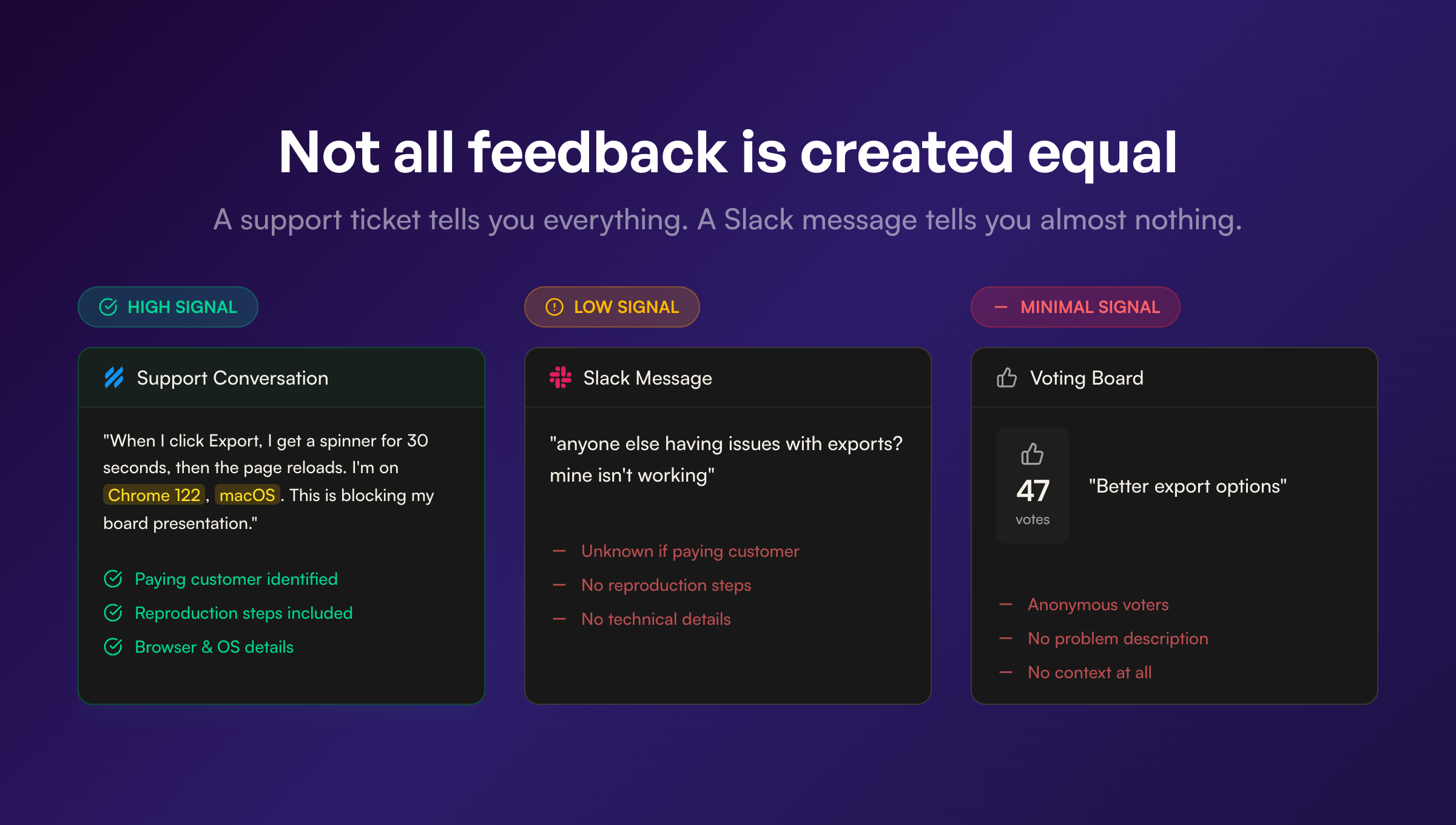
Support customers describe problems in detail
When someone messages your Slack community about a bug, they write something like: “anyone else having issues with exports?” That’s it. Maybe someone replies with a +1. Maybe not.
When the same person emails support, they write something like: “I’ve been trying to export my Q4 report for the last 20 minutes. When I click the Export button, I get a spinner that runs for about 30 seconds, then the page reloads and nothing downloads. I’m on Chrome 122, macOS. I tried Safari and got the same result. This is blocking my board presentation tomorrow.”
The difference is structural, not cultural. Support conversations are detailed because the customer needs help. They’re motivated to give you context because they want their problem solved. Slack messages are casual by design — short, ambient, easy to ignore.
This matters enormously for product decisions. A detailed bug report with browser version, steps to reproduce, and business impact is immediately actionable. A vague Slack message saying “exports are broken” requires three follow-up questions before you even know what’s happening.
Every reporter is identifiable
Support conversations are tied to real customers. You know their name, email, account, plan, and history. You can see how long they’ve been a customer, how much they’re paying, and what features they use.
Community channel feedback is often anonymous or semi-anonymous. A Slack message from “techfan42” might be a paying enterprise customer or a free-tier user who signed up yesterday. A Canny upvote tells you that some number of people want a feature, but you can’t weight those votes by revenue, tenure, or engagement.
This distinction matters for prioritization. A bug affecting three enterprise customers paying $500/month each is a different priority than the same bug affecting three free users. Support conversations give you that context automatically. Community channels don’t.
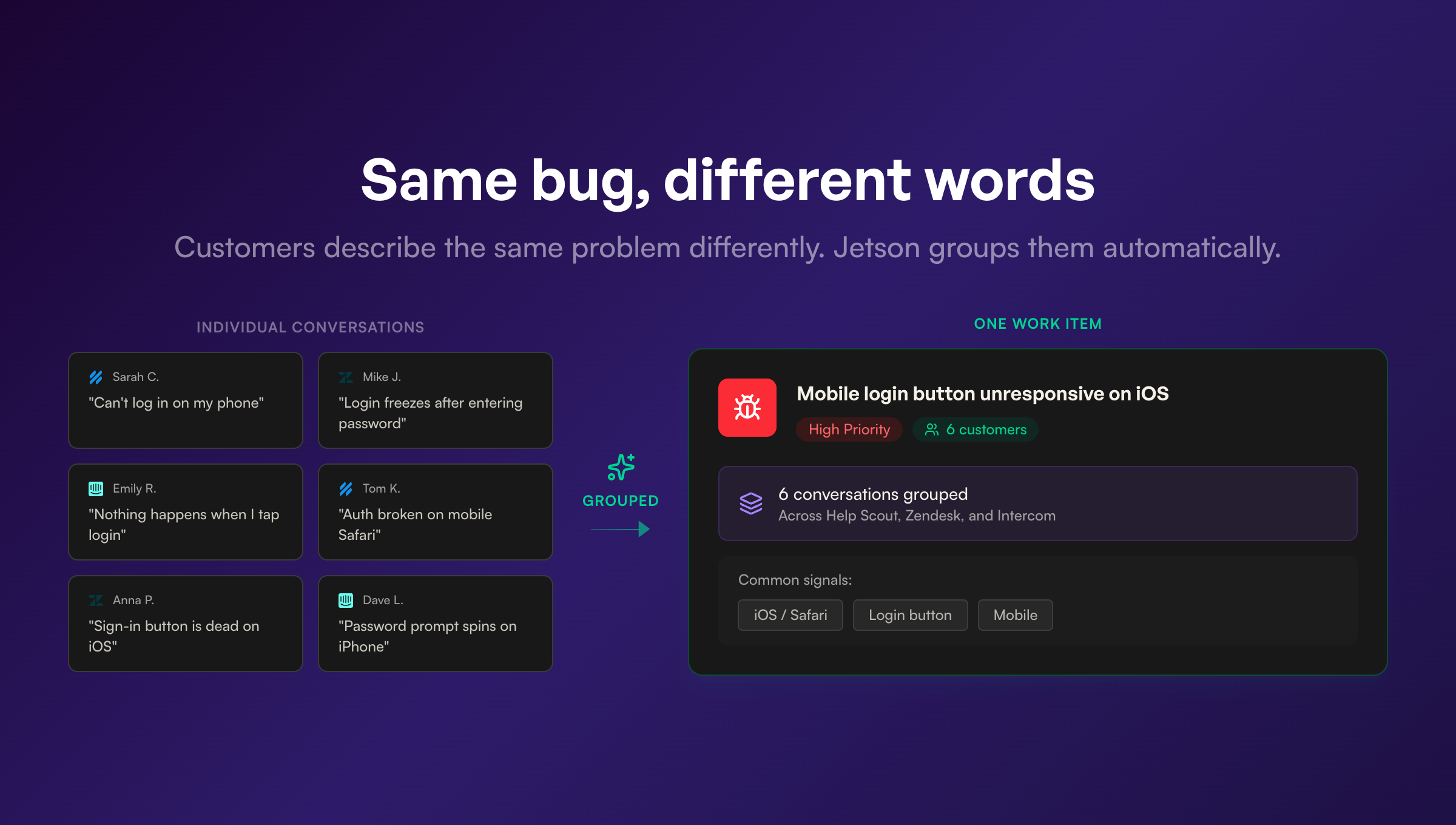
Volume is a built-in prioritization signal
When twelve customers email support about the same problem in a week, that’s a signal. Not a vague signal — a quantifiable one. You can count the tickets, identify the affected customers, and measure the trend.
Community channels don’t give you this naturally. Twelve people might mention the same issue in Slack over the course of a month, but unless someone is manually tracking every message and clustering them by topic, those twelve mentions look like twelve unrelated comments. The volume signal gets lost in the noise.
Support ticket volume correlates with severity in a way that other channels don’t. More tickets about the same issue means more customers are hitting it, which means it’s a bigger problem. This sounds obvious, but it’s remarkably hard to get this signal from Slack messages, survey responses, or upvote counts.
Support conversations represent paying customers with active pain
This is the most important structural difference, and it’s worth stating plainly: people who email support are paying customers experiencing real problems.
They’re not brainstorming. They’re not idly wishing for features. They’re stuck. Something is broken, confusing, or missing, and it’s blocking their work right now.
Compare this to other feedback channels:
- Canny upvotes: Someone thought a feature sounded nice. They may or may not actually need it. The act of upvoting takes two seconds and costs nothing.
- Slack messages: Could be from anyone — customers, prospects, community members, competitors. The context is often missing.
- NPS surveys: A score from 1-10 with maybe a one-sentence comment. Useful for trends, nearly useless for specific product decisions.
- Sales call notes: Represent what prospects say they want, which is different from what current customers actually need.
Support conversations sit at the intersection of “real customer” and “real problem.” That’s the highest-signal quadrant for product decisions.
The information is already there — you’re just not using it
Here’s the uncomfortable truth: most SaaS companies already have hundreds or thousands of support conversations containing actionable product intelligence. Bugs that keep getting reported. Features that customers keep asking for. Friction points that cause the same confusion over and over.
But this intelligence stays trapped in the support platform. Tickets get resolved, tagged, and closed. The customer got a response, so the ticket is “done.” The product insight inside that conversation — the pattern across hundreds of similar conversations — never reaches the product team.
This isn’t a people problem. Support teams are busy helping customers. They don’t have time to also write bug reports for engineering and feature summaries for product. And even when they try, the translation is lossy. A support agent summarizing a conversation will inevitably leave out details that a developer would find useful.
The gap exists because no tool was designed to bridge it. Support platforms are designed to help customers. Issue trackers are designed to ship code. Nothing sat between them and asked: “what are customers actually telling you, and who on your team needs to know?”
What this means for your product process
If you’re making product decisions based on Slack polls, Canny boards, or gut feeling, you’re working with a fraction of the signal available to you. Your support inbox contains:
- Bug reports with reproduction context: device info, steps taken, error messages, screenshots
- Feature requests with business justification: why the customer needs it, what they’re trying to accomplish, what they’re currently doing instead
- Friction patterns: the same onboarding confusion reported by ten different customers in ten different ways
- Severity signals: how many customers are affected, how urgent the problem is, whether it’s getting worse
The challenge isn’t generating this data — your customers are already generating it every time they email support. The challenge is extracting it, classifying it, and getting it to the right people on your team.
That’s a solvable problem. And it starts with recognizing that your support inbox isn’t just a queue of tickets to close. It’s the most honest, detailed, and actionable feedback your customers will ever give you.
We built Jetson from years of running SaaS products and reading every support ticket ourselves. Now it happens automatically — bugs, feature requests, and patterns surfaced from every conversation. If you want to see what’s hiding in your support inbox, try the free audit.