Last updated May 2026
Canny collects feedback. Jetson closes the loop.
Canny gives customers a portal to vote on ideas. Jetson reads your support conversations and generates bug reports and feature requests that a developer — or a coding agent like Claude Code — can pick up and fix. Customer quotes, reproduction context, and suggested code files included.
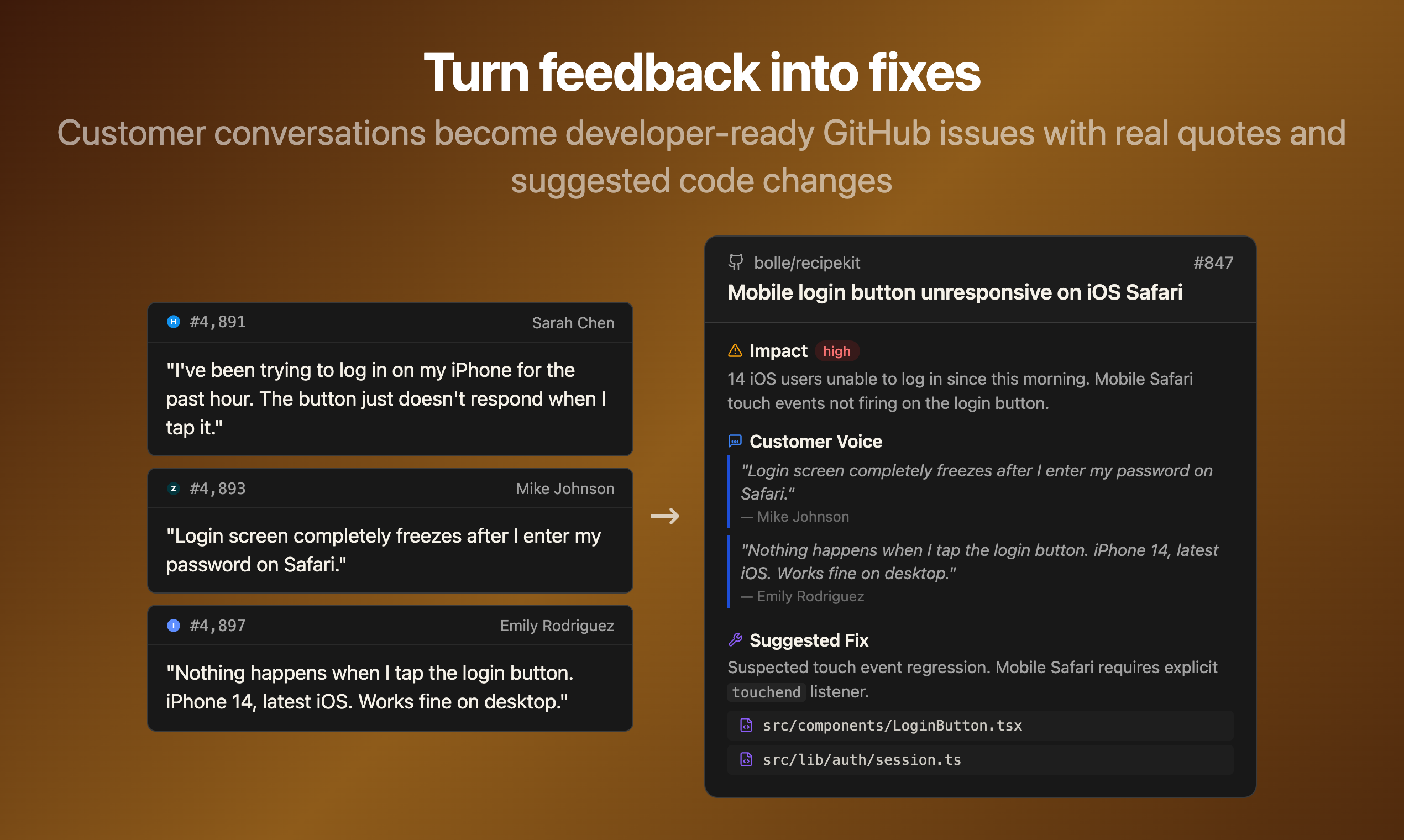
Why teams switch from Canny
Feedback sits in a portal. Nothing happens. Canny collects votes, but someone still has to read every item, decide what's a bug vs. a feature request, write up a ticket, and get it to engineering. Jetson does that automatically — from support conversation to GitHub issue in seconds.
Bugs don't belong on voting boards. Canny is built for "what should we build next?" But when a customer reports a broken checkout flow, that's not a vote — it's a bug. Jetson separates bugs from feature requests so engineering gets actionable reports, not popularity contests.
Work items that engineers can actually use. Canny links feedback to existing GitHub issues. Jetson creates new issues with customer quotes, reproduction steps, and suggested code files. An engineer — or a coding agent like Claude Code or Copilot — can pick up the issue and start fixing without asking "what did the customer actually say?"
Your customers already email support. Canny requires customers to visit a separate portal, write posts, and vote. Most never will — industry research puts portal adoption under 5% of active customers. Jetson analyzes the conversations you're already having in Help Scout, Intercom, or Zendesk. Zero extra effort for your customers.
Pricing scales with your customer count, not your support volume. Canny's tracked-user pricing means you pay more as you grow — the companies who most need feedback tools also hit the biggest bills. Jetson charges by conversations processed, starting at $49/month for 300 conversations, then $0.25 per overage. Predictable.
Autopilot uses credits that run out. Canny's AI classification is a separate add-on that consumes credits per action. When you hit the limit mid-month, classification pauses until next billing cycle. Jetson's classification is built in — every conversation, every month, no credit gatekeeping.
No more triage meetings. Canny surfaces the most-voted requests, but a human still has to decide what's a real bug, write the ticket, attach the customer context, and open a GitHub or Linear issue. Jetson does all four steps automatically — you review the generated issues, you don't write them.
Jetson vs Canny
Different approaches to product feedback
| Feature | Jetson | Canny |
|---|---|---|
| Approach | Automatic support analysis | Customer voting portal |
| Customer effort | Zero - just email support | Must use separate portal |
| Auto Classification | Bug vs feature vs noise | Autopilot (extra credits) |
| Help Scout | Native integration | Native integration |
| Intercom | Native integration | Native integration |
| GitHub | Creates issues with code context | Links to existing issues |
| Linear | Native integration | Native integration |
| Public Portal | Not our focus | Core feature |
| Voting Boards | Not our focus | Core feature |
| Pricing | $49/mo + $0.25/conv overage | From $19/mo, per tracked user |
Pricing: how the two models actually work
Per-tracked-user pricing penalizes growth. Per-conversation pricing scales with support volume.
$49/month for 300 conversations. Overage billed at $0.25 per conversation. Unlimited team members, unlimited customers, unlimited mailboxes up to your plan's limit.
- Scales with support volume, not customer count
- Classification is included, no credit add-ons
- All integrations included: Help Scout, Intercom, Zendesk, GitHub, Linear
Core starts at $19/month but scales by "tracked users" — each unique customer who interacts with your feedback portal counts. Growth and Business tiers unlock features and raise caps; Autopilot AI uses a separate credit system.
- Costs scale when your customer base grows, not with complexity
- Autopilot AI credits are a paid add-on on top of base plan
- Advanced integrations and automations gated to higher tiers
Real-world math: a 50-person SaaS team
With 5,000 active customers and ~400 support conversations a month, Canny's tracked-user pricing lands you in the Growth or Business tier (often $400+/mo), plus Autopilot credits. Jetson handles the same volume for $49/month base + ~$25/mo overage. The gap widens as your customer base grows.
How Jetson closes the loop
From conversation to work item
A customer emails about a broken feature. Jetson classifies it as a bug, extracts reproduction context, suggests relevant code files, and creates a GitHub or Linear issue — ready for a developer to pick up.
Bug reports that actually help
Every issue includes customer quotes with links back to the original conversation, how many customers are affected, and suggested code files. An engineer or a coding agent can start working immediately.
No portal in between
Canny funnels everything through a voting portal before it reaches engineering. Jetson sends classified issues straight to GitHub or Linear. Customer reports a bug at 2pm, engineering sees it at 2:01pm.
Bugs and features, separated
Canny treats everything as a feature request on a voting board. Jetson classifies each conversation as bug, feature, or noise. Bugs get triaged to engineering. Features get prioritized by customer count. Noise gets filtered out.
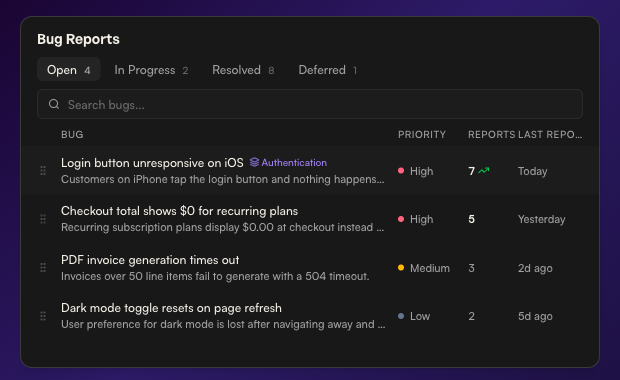
A bug report Jetson generated from a support conversation — ready to drop into GitHub or Linear.
Real scenarios: Canny vs Jetson
Three things that happen every week in SaaS support — and what each tool does with them.
Scenario 1
A customer reports a broken checkout flow at 2pm on Tuesday.
With Canny
Support agent reads the email, replies to the customer, and — if they remember — opens Canny, creates a post, tags it, maybe links it to a GitHub issue manually. Usually this step gets skipped because support is busy. The bug sits in Help Scout only.
With Jetson
Jetson classifies the conversation as a bug within minutes. A GitHub issue is created automatically with the customer's quote, reproduction context ("happens in Chrome on checkout step 3"), and suggested code files. Engineering sees it by 2:03pm.
Scenario 2
Eleven customers ask for Slack notifications over two weeks.
With Canny
Only customers who know the portal exists create posts — maybe 2 of the 11. The other 9 requests stay buried in support threads. The roadmap reflects portal votes, not real demand.
With Jetson
Jetson groups all 11 conversations into a single feature request, attaches each customer quote, and shows affected-customer count. The product team sees "11 customers asked for Slack notifications this month" — not 2 votes on a portal.
Scenario 3
Engineering wants context before fixing a reported bug.
With Canny
The linked GitHub issue has a title and a short description. Engineering pings support: "which customer?", "what browser?", "can you reproduce?" — context round-trips for an hour.
With Jetson
The issue already contains the customer's exact words, reproduction context, affected-customer count, and suggested code files to investigate. A developer — or a coding agent like Claude Code or Copilot — can start fixing without a single follow-up question.
Migrating from Canny to Jetson
You don't need to rip out Canny to try Jetson. Most teams run both during the switch.
Connect your support inbox (30 seconds)
OAuth into Help Scout, Intercom, or Zendesk. Jetson starts analyzing the last 30 days of conversations right away — so you can see what bugs and features would have been surfaced last month. No training period, no tagging taxonomy, no manual classification backfill.
Connect GitHub or Linear (30 seconds)
Jetson creates issues with customer quotes, reproduction context, and suggested code files. If you already link Canny posts to GitHub manually, Jetson replaces that step. If you don't, Jetson gives you the engineering-ready issues Canny never generated.
Decide what to do with Canny
If you use Canny purely for internal triage, most teams retire it once Jetson is running — triage happens automatically now. If you rely on Canny's public voting boards for customer-facing roadmap, keep it for that and let Jetson handle the support-to-engineering pipeline. The two solve different problems.
14-day free trial · No credit card required
Jetson is a better fit if you...
- Want bug reports that engineering can act on immediately
- Need issues created in GitHub or Linear with full context
- Want bugs separated from feature requests automatically
- Get most customer feedback through support conversations
- Don't want to manage another portal
Canny is better if you...
- - Need public feedback portals
- - Want customer voting on features
- - Want feature discovery and roadmapping
- - Don't need engineering-focused workflows
Frequently Asked Questions
Skip the portal. Get the insights.
Your customers are already emailing support. Jetson turns those conversations into bugs and features automatically.